For many, the marathon is the ultimate test. Something to dream of, to achieve maybe once in a lifetime. It’s the pinnacle. For a few, marathon running is what they do, what they train for, day in and day out. As the elite men and women line up for the London Marathon later this month seeking personal bests, glory, maybe even a record, they will be followed as ever by tens of thousands of other runners raising money for good causes. Inevitably, some will choose to be dressed as telephone boxes, firefighters and dinosaurs – because the marathon itself is not challenging enough. Whichever camp you fall into; the one-and-done, “cross the marathon off the bucket list”, the club runner striving to improve your PB after fitting training in around work and family, or the professional athlete whose job it is to be ready on that start line, the mythos of the marathon can be traced back over millennia.
A race with a legendary beginning
490BCE The Battle of Marathon. While versions of this story vary depending on the source material, it was the legend of Philippides, a foot courier in the Athenian army, running non-stop from the battlefield at Marathon to the Assembly in Athens to bring news of the city’s victory against the invading Persian army, collapsing into death as he delivered his message, which inspired the inclusion of the marathon at the first modern Olympic Games. Held on 10 April 1896, this first modern Olympic marathon traced Philippides’ journey from the battlefield to the city, a distance of approximately 24.8 miles. It was won by 23 year old Greek athlete Spyridon Louis in a time of 2:58:50.
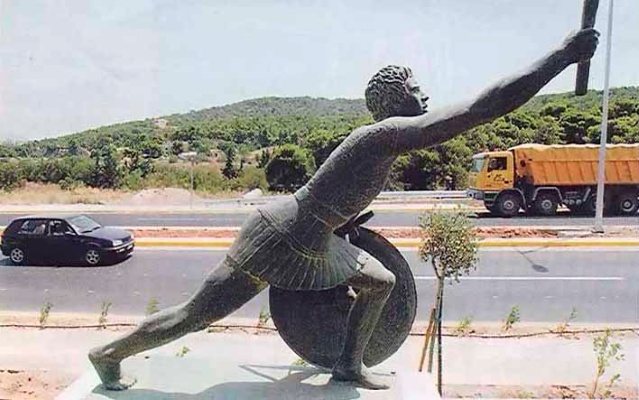
Image credit: CC BY-SA 3.0, via Wikimedia Commons
Finding its stride: the longest, the shortest, the most chaotic
Over the next few Olympic Games, the distance of the marathon wavered between 25 to 26.5 miles. The 1904 St Louis Olympic Marathon was one of the shorter, though perhaps most chaotic of all recorded marathons. The race started at 3pm and temperatures rose to around 32oC. The vehicles leading the runners and carrying spectators and coaches churned up a wall of dust which the runners had to run through. In addition to the heat and the dust, the course hadn’t been cordoned off in all places, so competitors had to contend with traffic, trolly cars, carts making deliveries (including everything underfoot that is associated with the horse as a means of transport), pedestrians and dog walkers. There were seven hills across the length of the course, rising between 100 and 300 feet, and only one point at the 12-mile mark where runners could take on water. One of the competitors, Felix Carvajal, a post man from Cuba stopped to eat some apples enroute and then suffering indigestion and stomach cramps, had a nap. Another, American Fred Lorz hitched a ride part of the way in a car – he finished the race but was disqualified. A third, Len Tau one of two black South African entrants – the first black athletes to compete in the modern Olympics – was chased more than a mile off course by dogs. Other runners dropped out across the race suffering dehydration, vomiting, and severe coughing fits brought about by the dust. The eventual winner, American runner Thomas Hicks made it to the finish line assisted along the way by coaches and handlers who fed him a concoction of strychnine – more usually used as a rat poison – and egg whites washed down with brandy. Doping was not illegal at this stage, and coaches were allowed to offer assistance. Hicks, who was near collapse towards the end of the race was half dragged half carried over the finish line in a time of 3:28:53, the slowest winning time for an Olympic marathon in history, giving us an idea of just how tough the course was. Of the 32 starters, only 14 made it to the finish line and Hicks had to be attended by 4 physicians immediately after the race before he was able to leave the stadium.
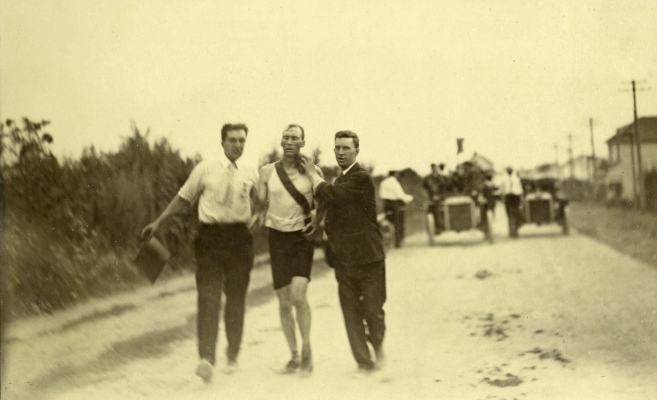
Image Credit: Unknown author, Public Domain, via Wikimedia Commons
The organisers of the 1908 London Olympic Marathon wanted the race, which started in Windsor, to finish in front of the Royal Box in the Olympic Stadium at White City after a final lap of the track, a now familiar distance of 26 miles 285 yards. It was won in a time of 2:55:18by American athlete Johnny Hayes. In fact, Hayes finished in second but was awarded gold upon the disqualification of Italy’s Dorando Pietri. Pietri had been leading the race on entering the White City Stadium however he collapsed near the finish line and received help from officials in order to complete the race, something which would have passed unremarked on in the St Louis race four years prior.
While the 1908 London Olympic distance is the standard race length these days, it wasn’t until 1921 that the IAAF finally settled on this as the official distance. The 1920 Antwerp Olympic Marathon was the longest, at 26 and a half miles. It was won by Hannes Kolehmainen of Finland in a time of 2:32:35.
Women’s marathon
Marathon running was seen, at least by the establishment, as a purely male pursuit. Women’s athletics was restricted to much shorter distances – the 800m was run at the 1928 Games and then not again until Rome 1960 – for fear that women’s bodies would not withstand the pressures of long, or even middle-distance running. Despite this, women have always run. There are records of women’s games, the Herean Games, contemporary with the ancient Olympic Games in Greece which included footraces in honour the Goddess Hera. There are records from seventeenth century Britain of women competing over long distances, and the day after the first Olympic marathon in 1896 Greek woman Stamata Revithi ran the course in a time of 5.5 hours (though she was prevented from entering the stadium).
In the UK, Violet Piercy ran several marathon distances in the 1920s, but without official competition recognition. Scottish cross-country champion Dale Greig ran the Isle of White marathon in 1964. Competing unofficially, she set off 4 minutes before the men and completed the race in 3:27:25 setting a British record which would stand for the next 11 years. She was followed the entire way round the course by an ambulance.
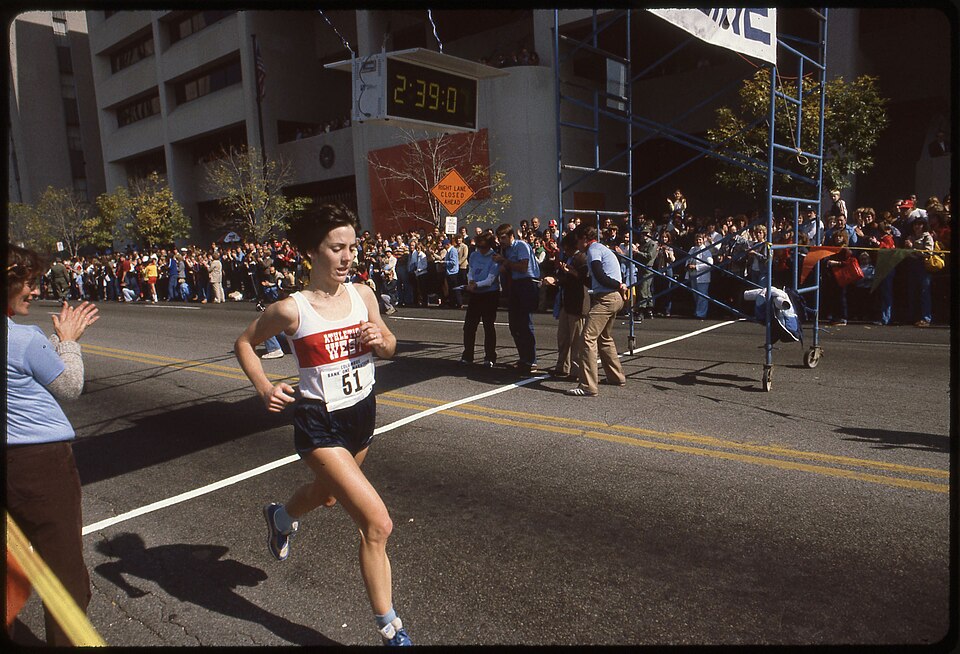
Image Credit: Columbus Metropolitan Library, Public domain, via Wikimedia Commons
Across the Atlantic, Roberta Gibb was the first woman to unofficially complete the Boston Marathon. Having applied to compete in 1966 and been told by the race director that women were not physiologically capable of running marathon distances, she hid in a bush near the start line and jumped into the race once about half the starting pack had passed. Katherine Switzer the next year officially entered and completed the Boston Marathon in a time of 4 hours 20 minutes. She had filled out the registration using her initial K.V. Switzer, and there was no requirement to state her gender – what was the need when it was implicitly understood that the marathon was a male only event? On race day, the organiser was horrified to realise there was a woman taking part and tried to forcibly remove her from the race as she ran. She evaded them, with the help of the (male) runners around her and went on to complete the marathon.
The marathon was finally incorporated into the Olympic programme for women at the 1984 Los Angeles Games where it was won by Joan Benoit of the USA in 2:24:52.
World bests to world records
Interestingly, there were no world records in the marathon until 2003 when Kenyan athlete Paul Tergat ran 2:04:55 in the Berlin Marathon. Prior to this, possibly owing to the variations in courses (and in earlier years, distances) there were world bests, but no ratified records. Today, not all marathon courses are certified, meaning a world record can only be set in a handful of races.
Since 2003, the men’s record has been broken 8 times, twice by the holder improving his own time; Hailie Gabreselassie of Ethiopia improving from 2:04:26 in 2007 to 2:03:59 in 2008, and Kenya’s Eliud Kipchoge taking the record from 2:01:39 in 2018 to 2:01:09 in 2022. The current men’s world record time of 2:00:35 was set by Kenyan athlete Kelvin Kiptum in the Chicago 2023 marathon. The two-hour mark remains to be broken.
On the women’s side, there are two records currently – the record for a women’s only race is 2:15:50 set by Tigst Assefa of Ethiopia in the 2025 London Marathon elite women’s race. The current women’s world record set in a mixed race is 2:09:56, set by Kenyan athlete Ruth Chepng’etich in the 2024 Chicago marathon.
As elite athletes and club runners alike finalise their training for this year’s London Marathon, plus high tech shoes, energy gels, chafe balm and possibly a costume, and hopefully minus brandy, strychnine and choking dust, we await to see whose name will be written into the next chapter of the marathon legend.