The first five-footer: the short, spectacular career of Phyllis Green
By Phil Minshull
On 11 July 1925 Phyllis Green became the first woman to clear five foot in the high jump. Though not as celebrated as the likes of Roger Bannister’s first sub-four-minute mile, it remains a hugely important landmark in British and global athletics.
Green had a short but spectacular career, a super-talented teenager from south London who, briefly, became a sporting celebrity in the Roaring Twenties. Her historic performance came in an era when women’s athletics was starting to get greater prominence, though it was still three years before women athletes made their debut on the Olympic stage at the 1928 Games in Amsterdam.
Born on 8 February 1908 in Peckham, southeast London into a middle-class family, her father Henry was a manager at a successful undertakers. Green would later say that she won a myriad of sports day prizes across all events at the local girls’ high school, often beating girls up to three years older than her.
Having left school a few years earlier, with the school-leaving age only having been raised to 14 in 1918, in either late 1924 or early 1925 Green joined the London Olympiades Athletic Club, Great Britain’s first women-only club which had been formed in 1921. In what appears to be her first ever outing for the club, 17-year-old Green made a spectacular debut when she cleared 4’11½” (1.51m) on 6 June 1925 at the ‘Daily Mirror’ Trophy’ meeting, with some reports also suggesting she tried unsuccessfully that afternoon to clear 5’0” (1.524m). Into the bargain, at that meeting she also broke the British long jump record with a 17’2½” (5.24m), just six centimetres short of Czechoslovakian athlete Marie Mejlikova’s world record, ratified by the France-based International Women’s Sports Federation (FSFH) which governed women’s athletics before the International Amateur Athletic Federation brought it under its aegis in 1934.
“A wonderful new girl athlete was discovered during the women’s inter-club athletic contest at Stamford Bridge on Saturday. Though she is only just over seventeen and was competing for the first time at an open meeting, Miss Phyllis Green broke world records!”
Daily Mirror, Meeting sponsors
In fact, her high jump mark equalled the mark of Belgium’s Ellen van Truyen set at the International Women’s Games at the same venue the previous year but there wasn’t quite the attention to detail that is usually prevalent nowadays.
However, in little more than a month, Green would make the world record her own.
Celebrity status
Her Stamford Bridge feats provided instant fame, and the Daily Mirror even despatched a photographer to take pictures of her the following week while she was on holiday at the seaside.
Green was soon back in action on 5 July, representing London in an inter-city match involving Brussels and Paris in the Belgian capital and once again cleared 1.51m, the only time in her life she competed in a competition with metric measuring.
One week later, Green returned to Stamford Bridge – these days home to Chelsea F.C. – for the third edition of the Wormen’s Amateur Athletics Association (WAAA) Championships.
After what was described as an “enthralling duel” with Hilda Hatt, winner of the 1922 Women’s World Games and inaugural 1923 WAAA high jump title, Green duly made history by clearing of 5’0” (1.524m), while Hatt had to settle for second with 4’10”.
“For that marvellous moment, even as you realise that you have cleared that far greater height than your fellow competitors, you feel as though you are in the clouds trailing glory behind you. I can’t imagine anything that is comparable with this experience,” Green wrote, almost predicting her record, when writing in the Daily Express the previous week in a column entitled ‘Sports Thrill for Girls’.
Courtesy of Bourne Hall Museum
Finishing off her superlative summer, in the only international appearance of her short career, Green took maximum points for Great Britain in a match against Canada and Czechoslovakia at Stamford Bridge when clearing 4’10” (1.47m) on 1 August.
Despite no further records that day, few seemed disappointed, and to confirm her celebrity status Green once again made the front pages of several daily newspapers.
Photos show a packed stand down the home straight as well as good crowds on the terraces many of whom had come to see Green, attesting to the growing popularity of women’s athletics.
Memorable jumps double
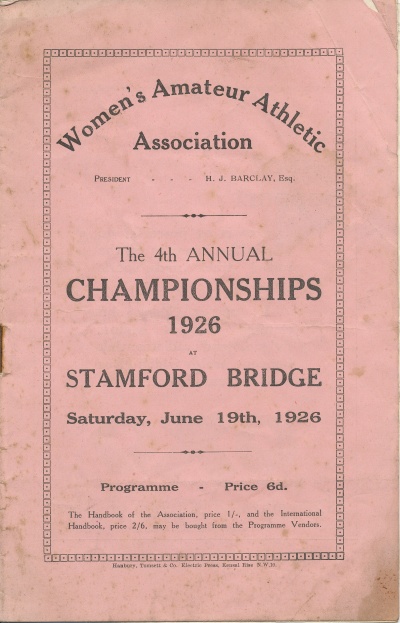
Green went on to even greater heights in the following two years and commanded plenty more headlines. She won both the high and long jump at the 1926 WAAA Championships on 19 June, a feat not equalled for another 29 years, with 4’10” and 16’6¼” (5.03m).
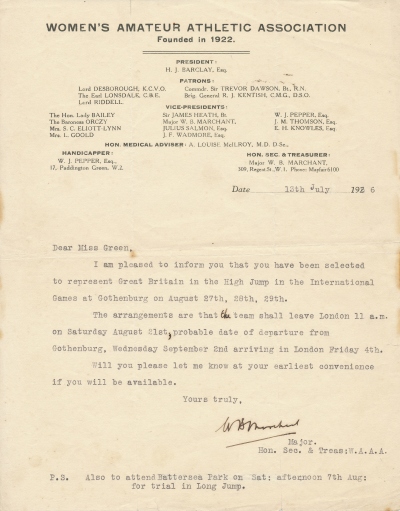
The following month she was selected for the high jump at the 1926 Women’s World Games in Gothenburg which were scheduled for 27-29 August as well as invited to take part in a long jump trial. For reasons that are not clear, Green decided to decline selection for the trip to Sweden.
Green’s invitation from WAAA to represent Great Britain in the Women’s International Games in Gothenburg, 1926. This was the highest level of international competition available to women athletes prior to their inclusion in the Olympics from 1928. Courtesy of Bourne Hall Museum
It has been speculated that this might have been for religious reasons as Green didn’t compete on Sundays but as the high jump was scheduled for the first day, a Friday, this seems unlikely. A more plausible reason could be that the team was expected to be away for two weeks; as she was involved in the running of her father’s prospering undertaking business, it was not practical for her to take the time off. The high jump competition was won by France’s Helene Bons with 1.50m.
However, at the Chiswick Charity Sports at Turnham Green on 2 August, the August Bank Holiday weekend – the same day that fellow athlete Muriel Gunn set the first of her two ratified long jump world records four miles away at Stamford Bridge – Green cleared 5’1⅛” (1.5526m) to improve her own official world record, the bar being originally set at 5’1” but then re-measured for record submission.
Third world record denied
At the WAAA Championships in Reading 1927, Green won the high jump for the third consecutive year, clearing 5’2¼ from a grass take off – the bar likely to have been set at 5’2” but once again adjusted after being re-measured – a mark which was ultimately to be her personal best.
Translating metrically to 1.58m, Green’s jump theoretically equalled the world record of Canada’s Ethel Catherwood but it was not ratified by the FSFH as it was ³⁄₁₆ of an inch less than Catherwood had jumped in a local competition in September 1926.
And then Green disappeared from the sport almost as meteorically as she appeared a little over two years earlier.
No records exist of Green ever competing again after the end of 1927 and she did not compete at the 1928 Olympic Games, the first to allow women athletes.
If she had competed in Amsterdam, she would have gone head-to-head with Catherwood, who eventually won the gold medal with a leap of 1.60m (re-measured and ratified at 1.595m).
She would also have had a tilt at the accolade of Great Britain’s first woman athlete to win an Olympic medal, an honour eventually achieved by the 4x100m team who finished third in Los Angeles four years later.
Questions unanswered
Why Green suddenly retired from the sport she was so successful at, despite still being only 19, remains unanswered to this day.
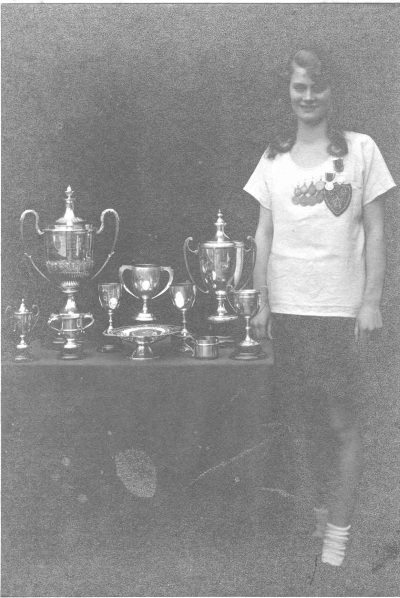
Courtesy of Bourne Hall Museum
Local historians in Ewell, the town close to London where Green lived for many years from the late 1930s until she died in 1999, have done some delving into her family archives.
They have speculated, with some substance, that it was probably because she was involved with her family’s increasingly successful undertaking business, which was taken over by her brother Cyril after her father’s death in 1934.
After all, despite her celebrity, there were no shoe contracts, no sponsorship and no appearance fees for athletes in the 1920s.
The loss of income was almost certainly a factor in Green not accepting the invitation to go to the 1926 Women’s World Games.
She appeared to continue to work for the family business until she married a Presbyterian minister, George Nicol, in 1946. She then embarked on the life of a missionary’s wife with frequent trips to Malaya until George suddenly died in 1957 and she returned to live in Ewell.
Green herself died on 28 November 1999 at the age of 91 and, sadly, the importance of her athletics career went largely unrecognised during the last decades of her life.
No first hand accounts that would answer some of the questions about her career have entered the public domain but that doesn’t diminish her impact.
Six foot in imperial measurement was subsequently scaled when Romanian athlete Iolanda Balas cleared 1.83m in 1958, East Germany’s Rosi Ackermann was the first woman over two metres in 1977, and seven foot now beckons on the horizon after Yaroslava Mahuchikh improved the world record to 2.10m last year.
However, Phyllis Green will always have her place as one of the early icons of women’s athletics.
With thanks to Sue Dalloe and Vicky Rowley at the Bourne Hall Museum, Ewell, for their assistance. An edited version of the article first appeared on the World Athletics websitewww.worldathletics.org